

Director Value Excellence Hub
Water scarcity, climate change, and regulatory pressure are no longer abstract future risks for industry—they are daily operational realities. Across Europe and other industrial regions, companies are facing increasing water costs, stricter discharge limits, and growing uncertainty around long-term water availability. In this context, ensuring access to reliable water is becoming just as critical as energy security or raw material supply.
For many industrial facilities, cooling systems sit at the heart of this challenge.
Cooling Towers: A Major Lever for Water Savings
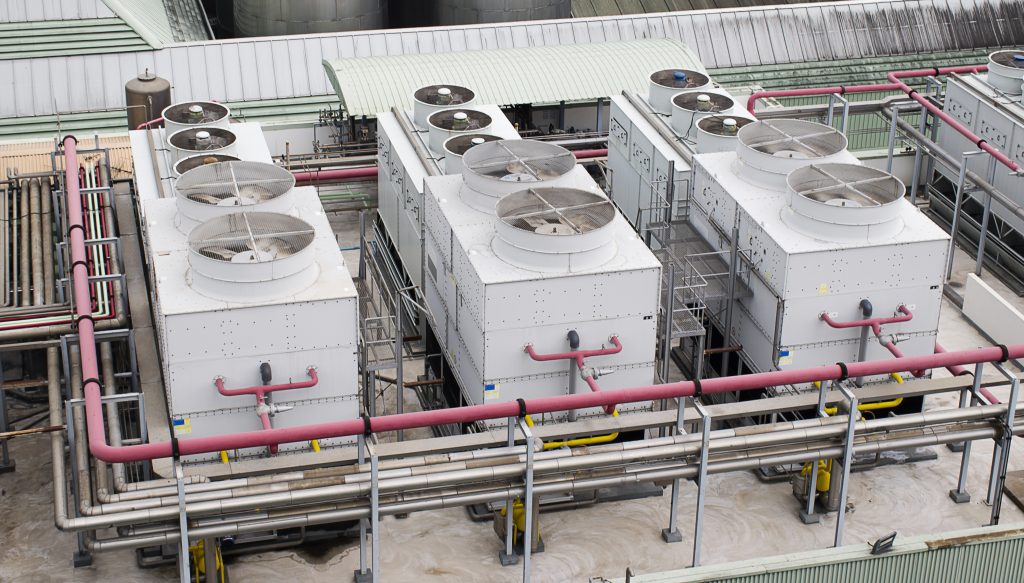
Cooling towers are essential to industrial operations, supporting heat removal in sectors ranging from petrochemical and chemical production to food & beverage, power generation, and manufacturing. At the same time, they are among the largest consumers of water in a typical plant, often accounting for up to 40% of total site water use.
Traditionally, water management strategies have focused on treating fresh make-up water before it enters the cooling system. While this can improve water quality, it does little to address overall water dependency or wastewater generation. A much greater opportunity lies in rethinking how cooling tower blowdown is managed.
Blowdown is discharged to control the concentration of salts and impurities in the cooling circuit. Because it is more concentrated than make-up water, it has historically been viewed as difficult and risky to reuse. However, this same concentration makes blowdown the most impactful stream for water valorization.
Why Blowdown Reuse Delivers Higher Impact
Reclaiming cooling tower blowdown allows facilities to significantly reduce both freshwater intake and wastewater discharge. Compared with treating make-up water, blowdown reuse typically delivers:
- 20–40% reduction in freshwater consumption
- Substantial reduction in wastewater volumes and discharge costs
- Lower energy consumption due to smaller treated volumes
- Improved water and CO₂ footprint performance
- Faster return on investment and stronger economic outcomes
In addition, blowdown reuse directly increases water resilience. By internally recycling water, facilities become less exposed to seasonal droughts, supply restrictions, or sudden price increases.
Addressing the Technical Challenges
Despite its benefits, blowdown reuse is technically demanding. Higher concentrations of dissolved solids, organics, and biological matter increase the risks of fouling, scaling, corrosion, and biofouling, particularly in membrane systems.
Many water recovery projects fail because these risks are underestimated or managed in isolation. Successful blowdown reuse requires an integrated approach that combines deep cooling water expertise with advanced membrane treatment know-how.
This includes:
- Optimised cooling water chemistry to control corrosion, scale, and biofilm
- Correct selection and design of filtration, ultrafiltration, and reverse osmosis
- Advanced antiscalants, biodispersants, and membrane-compatible chemicals
- Accurate prediction of real scaling behavior, avoiding overdesign and overdosing
- Continuous monitoring and proactive operational control
When cooling systems and water recovery units are designed and operated as one integrated system, stable and reliable blowdown reuse becomes achievable.
Traditionally, water management strategies have focused on treating fresh make-up water before it enters the cooling system. While this can improve water quality, it does little to address overall water dependency or wastewater generation. A much greater opportunity lies in rethinking how cooling tower blowdown is managed.
Blowdown is discharged to control the concentration of salts and impurities in the cooling circuit. Because it is more concentrated than make-up water, it has historically been viewed as difficult and risky to reuse. However, this same concentration makes blowdown the most impactful stream for water valorization.
From CapEx to OpEx: Water Recovery as a Service
Another major barrier to implementing water reuse projects is capital investment. Utilities projects often compete with core production assets and are postponed until water scarcity becomes critical—by which time costs and risks are significantly higher.
A reclaimed water supply service model changes this dynamic. Instead of purchasing equipment, facilities move to an OpEx-based approach where the system is designed, built, operated, and continuously optimised as a long-term service.
This model:
- Reduces upfront financial risk
- Simplifies budgeting and cost forecasting
- Guarantees water production and performance
- Frees internal teams to focus on core production priorities
Most importantly, it ensures that water recovery systems continue to perform reliably over time, even as operating conditions, regulations, or water quality change.
Proven Results Across Industries
Industrial references across petrochemical, food, and other sectors demonstrate what is achievable with the right approach:
- Up to 40% reduction in make-up water consumption
- Up to 80% reduction in blowdown discharge
- Increased cycles of concentration while maintaining corrosion control
- Compliance with increasingly strict local water regulations
These results are delivered not as one-off projects, but as sustained, monitored performance over the lifetime of the service.
Building Water Resilience for the Future
Water challenges will continue to intensify. Facilities that act early can transform water from an operational vulnerability into a managed, strategic resource—protecting production, controlling costs, and supporting long-term sustainability goals.
Reclaiming cooling tower blowdown is no longer just a technical option. It is a strategic decision that strengthens resilience and prepares industrial sites for an increasingly water-constrained future.
Want to explore how cooling tower blowdown can be transformed into a reliable water resource for your facility?
Watch our on-demand webinar on Reclaimed Water Supply Services, where our experts explain the technical, economic, and operational aspects of blowdown reuse and share real industrial case studies.
Access the Webinar