Legionella Under Control with Dilurit® BC S-System
Background
At an oil refinery, the cooling water system was initially treated using a bromine-based biocide and was subsequently converted to a chlorine dioxide-based treatment. Despite continuous application of both biocides, the refinery increasingly experienced microbiological challenges, including elevated total bacterial counts and significant Legionella exceedances.
In the same period, cooling water systems became subject to compliance with the newly implemented 42nd Federal Immission Control Ordinance (42.BlmSchV), increasing regulatory pressure regarding Legionella control. Additional treatment approaches were therefore evaluated and tested over extended periods; however, the microbiological issues persisted. Due to ongoing regulatory exceedances, compliance requirements, and operational risks, refinery management decided to evaluate an alternative treatment strategy using Dilurit® BC S-System.
System Description
The application concerns Cooling Tower 11 (CT 11) at an oil refinery. The system consists of two parallel cooling tower units (CT11‑1 and CT11‑2) operated as a recirculating cooling water system under continuous service conditions.
The cooling tower is designed for year‑round operation with stable thermal performance and is supplied with make‑up water to compensate for evaporation and blowdown.
The system is operated using an all‑organic water treatment concept and under conditions that promote microbiological growth, such as elevated operating temperatures, continuous circulation, and organic load.
Due to these boundary conditions, Cooling Tower 11 represents a microbiologically demanding application, requiring a robust and reliable biocide treatment to ensure long‑term control of biofilm formation and Legionella.
| Parameter | Value |
|---|---|
|
Number of cooling tower units |
2 (CT11-1 & CT11-2) |
|
Basin volume per unit |
2000 m³ |
|
Circulation flow per unit |
8000 m³ |
|
Make up water flow |
2 × 138 m³ |
|
Blowdown |
~ 120 m³ |
|
Temperature difference (ΔT) |
~ 6 °C |
|
Concentration factor |
~ 2.3 |
|
Operating time |
8,760 h/a |
|
Water treatment concept |
All organic |
Objectives
- Achieve reliable compliance with Legionella requirements
- Reduce and stabilize total bacterial counts
- Eliminate persistent microbiological problems
- Improve operational safety and reliability of the cooling system
Action/Approach
Prior to implementation, the cooling water system was assessed through detailed water analyses and system data evaluation. Based on these results, the dosing strategy and required dosage of Dilurit® BC S-System were defined for effective microbiological control under refinery‑specific operating conditions.
Dilurit® BC S-System was applied using 3–4 shock doses per week, each targeting approximately 4 ppm total chlorine (measured in the cooling water). After this preparatory phase, the existing biocide treatment was discontinued and the system was fully converted to Dilurit® BC S-System.
The dosing concept was designed to control both planktonic microorganisms and established biofilms. During commissioning, microbiological parameters were closely monitored to verify system response and confirm rapid stabilization.
Achievements
The microbiological performance of the cooling water system was documented through continuous monitoring before and after the transition to Dilurit® BC S-System.
Legionella Concentrations
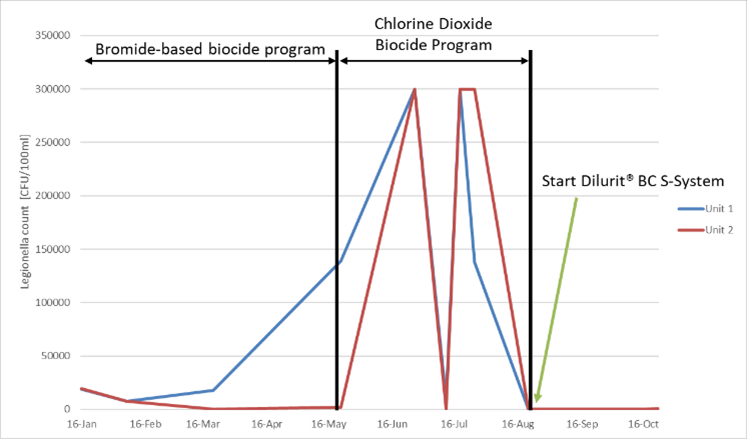
The first graph shows that, under the previous biocide regime, Legionella concentrations increased significantly, reaching both elevated and critical levels.
After conversion to the Dilurit® BC S-System, Legionella concentrations decreased rapidly within approximately 7–14 days, dropping to values at or close to the detection limit (<100 MPN/100 ml). Over the following months, Legionella levels remained consistently low with no renewed critical excursions.
Total Bacteria Count
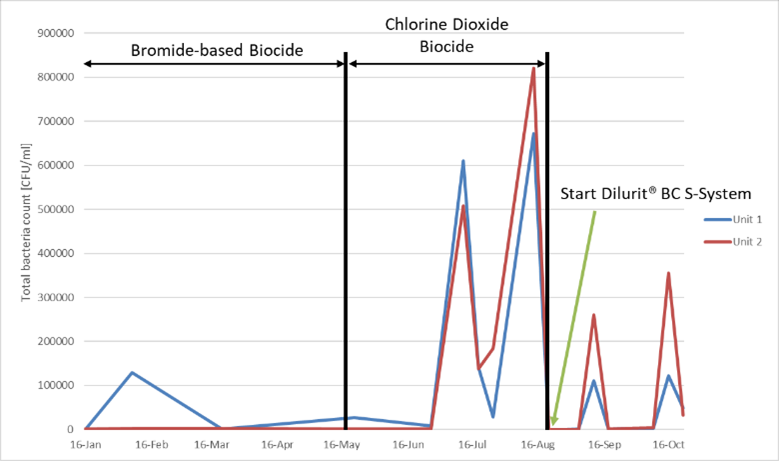
Total bacterial counts before Dilurit® BC S-System application showed strong fluctuations and extreme peaks, with values temporarily exceeding 6 × 10⁵ to 8 × 10⁵ CFU/ml. Such peaks indicated unstable microbiological conditions and insufficient long‑term control.
Following the implementation of Dilurit® BC S-System, total bacterial counts were significantly reduced, stabilizing predominantly below 1 × 10⁵ CFU/ml, with only short‑term, limited increases. Overall, the system showed markedly improved stability and reduced amplitude of microbial peaks
After system stabilization, the dosing interval was optimized and reduced to two times per week after approximately three months of operation, without loss of microbiological control.
Conclusions
The documented monitoring data clearly demonstrates the effectiveness of Kurita’s Dilurit® BC S-System in controlling microbiological growth in a refinery cooling water system.
By addressing both planktonic microorganisms and biofilm‑related activity, Dilurit® BC S-System enabled rapid recovery from critical microbiological conditions and delivered sustained long‑term stability. The successful application at the oil refinery confirms Dilurit® BC S-System as a robust, reliable, and competitive biocide for demanding refinery cooling water environments.
- Rapid proof of concept under real refinery conditions
- Clear performance improvement confirmed by monitoring data
- Successful replacement of the existing biocide treatment
- Demonstrated long‑term reliability after conversion
Kurita’s Technology: